In our first post we argued that the shared distribution transformer is the missing piece in distributed AI computing, and that every node behind one transformer should be governed as a group with one power budget. We promised to test that on real data before building hardware. This is what the first round of testing showed, and it changed where we think distributed AI should go first.
The short version: buildings with large, lightly used transformers, such as schools, offices and government buildings, can host hundreds of compute nodes while keeping the transformer within its rating. A street of homes sharing a small transformer can host almost none.
How we tested it
- Real building loads. Fifteen-minute electricity profiles for Charlotte-area homes, apartments, a public high school, offices and a government building from the U.S. Department of Energy's public ResStock and ComStock datasets, with the actual 2018 weather. These are calibrated building models, not metered buildings.
- A standard transformer model. The thermal model in IEEE C57.91, the industry guide for loading oil-filled transformers, tracking oil and winding temperature and insulation aging every 15 minutes for the whole year.
- A compute node drawing 1.23 kW at full load.
- A full year per site, including ten simulated demand-response events and realistic errors in the next-day temperature forecast.
For each site we searched for the largest number of nodes that meets three tests: the nodes are available at full power for at least 95% of their possible hours, the transformer's hot spot never exceeds 120 °C, and every demand-response event is honored. The 95% figure is modeled full-power availability. It is not completed AI workloads or actual GPU revenue.
What we changed after a stress test
Our first controller kept the transformer under its temperature limit, but an outside review asked a harder question: how long does it keep the transformer above its nameplate rating? The answer was too long. At the school it ran above nameplate for about 8,100 hours of the year, including one stretch of 666 hours. No utility would accept that, whatever the temperature model says.
So we rebuilt the controller to be conservative:
- It never plans computing load that would take forecast transformer loading above 100% of nameplate.
- It targets a 110 °C hot spot, the temperature at which transformer insulation ages at its normal rate.
- It plans an hour ahead, against a four-hour thermal look-ahead.
- It switches whole nodes on and off at full power, so every counted hour is a full-speed computing hour.
- Below it, the proposed design adds a fast local loop that would measure the transformer's actual load at least once a second, and an independent hardware trip (a current relay and a watchdog relay wired into the computing contactor) that would disconnect the computing load if the software fails, never the building. These are specified designs, not yet built or tested.
That approach is the subject of our second U.S. provisional patent application, filed November 2026.
The conservative approach significantly reduced the number of computing nodes each site could support. It also exposed the difference between managing forecast transformer loading and guaranteeing actual operating limits. Unexpected building demand still produced brief exceedances in the simulation, which is why our proposed design includes a fast local control loop and independent protective hardware. Those systems will require physical validation before deployment.
The results
| Site | Transformer | Nodes hosted | Worst hot spot | Aging (h/yr) |
|---|---|---|---|---|
| Public high school, 75,000 ft² | 750 kVA | 492 | 110.2 °C | 951 |
| Large office | 1,500 kVA | 290 | 104.9 °C | 204 |
| Government office | 300 kVA | 137 | 109.1 °C | 461 |
| Apartment complex, 36 units | 112.5 kVA | 34 | 104.1 °C | 174 |
| Residential street, 8 homes | 37.5 kVA | 3 | 102.6 °C | 40 |
| Manufacturing, two shifts | 225 kVA | 0 | — | — |
The controller limits planned computing load, so it cannot stop a building's own demand from jumping unexpectedly. In the simulation that happened in a handful of single 15-minute intervals: 3.5 hours in the whole year at the school, with the worst single interval at 140% of nameplate when the building's load spiked on a winter morning. The simulated controller had no fast loop, so these figures show the exceedances the fast loop and hardware trip are meant to address. Insulation aging stayed well below normal at every site.
Why schools work and streets don't
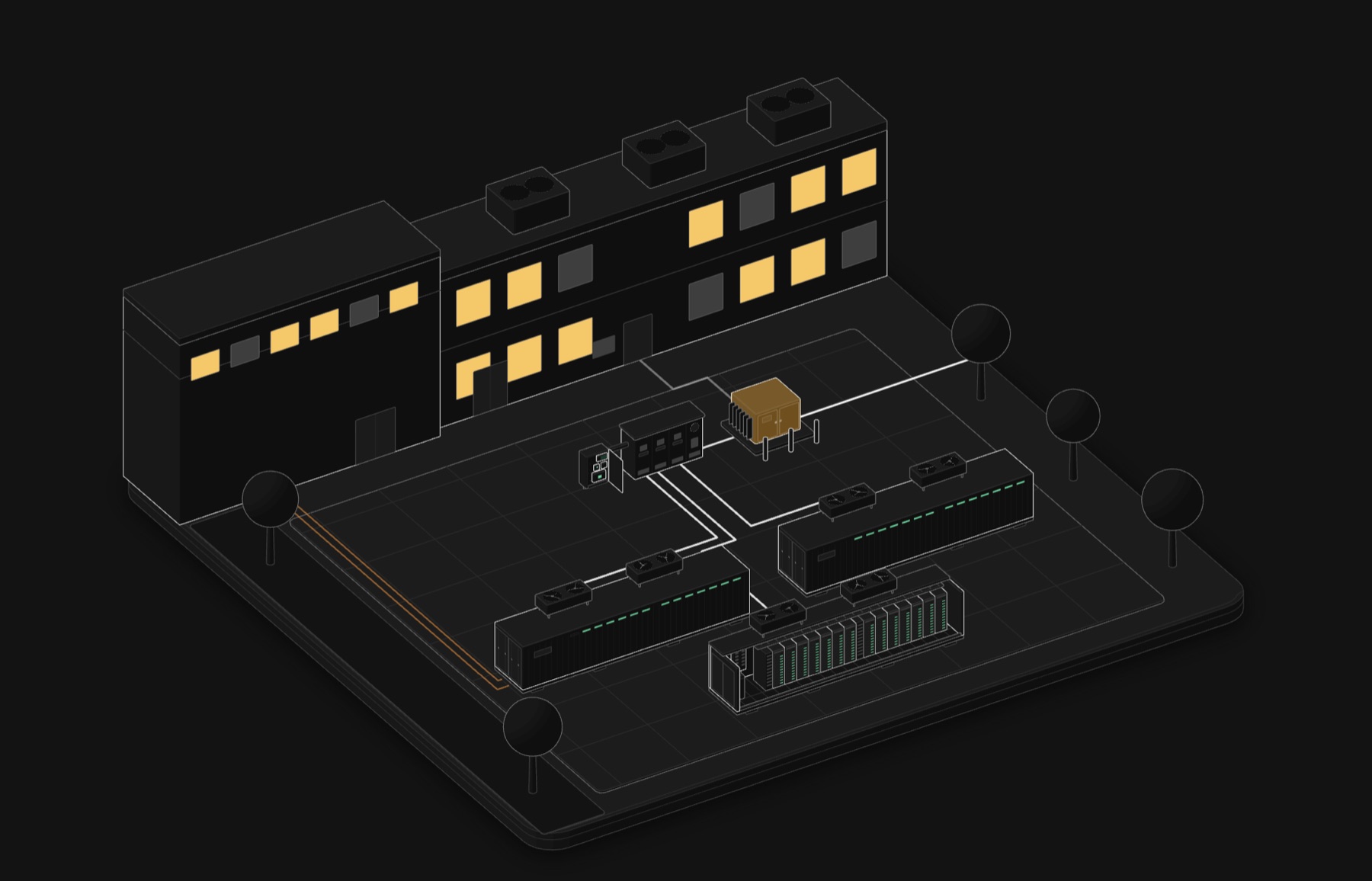
That is a substantial installation. At 1.23 kW per node, 492 nodes are about 605 kW of computing load and about 605 kW of heat at full power, roughly 200 kW per enclosure, before cooling and distribution losses. That is a small data center, not a cabinet in a school equipment yard. The 492-node figure is a simulated transformer-capacity result, not a recommended deployment size. A real site's size will depend on its measured transformer data, its electrical infrastructure and its cooling.
A school's transformer is sized for a few hours of peak demand on school days. Its building load peaked at 67% of the transformer's rating, and most hours of the year it sits far lower: nights, weekends, holidays and summer. The conservative controller fills that idle capacity and backs off when the building needs it, during the winter morning warm-up or a hot afternoon.
A residential street is the opposite. The eight homes we modeled already load their 37.5 kVA transformer to 99% at the hottest afternoon peak. There is almost no room left, and only three nodes fit within the conservative rules. Shared-transformer homes are a hard case for distributed AI, not the place to start.
The two-shift manufacturing site hosted nothing: its own load keeps the transformer busy 16 hours a day.
What the economics say
We also costed each node the way a compute provider would: its electricity on its own meter, network, maintenance, insurance and $5,000 of hardware financed over five years. We used illustrative rental rates rather than a market median. Public marketplaces listed RTX 5090-class GPUs at roughly $0.20–0.70 an hour in November 2026 (for example getdeploying and Vast.ai), and prices move quickly. At an assumed $0.50 an hour with 60% of hours rented, a provider could afford a hosting fee of roughly $7 per node per month. At $0.65 an hour, that rises to about $70.
The business case is sensitive to GPU prices and utilization, so hosting agreements should share revenue rather than promise a fixed fee. For a school hosting 492 nodes, even a modest share is meaningful. At $20 per node per month it would be about $118,000 a year, but only where prices and utilization support it.
Limits, plainly
- These are simulations on modeled loads, assumed transformer sizes and typical thermal parameters, not field measurements.
- One building per type, in one county, for one year.
- Interconnection, permitting, noise, cooling design and the hosting agreement are not modeled.
- Every site needs its own hosting-capacity study on its own metered data before any equipment is sized.
What's next
The lesson we take from this: distributed AI computing should be deployed where measured electrical headroom exists, not simply wherever there is space and an internet connection.
We're now looking for a first institutional site: a school district, municipality, office owner or government facility with a large, lightly used transformer. We would run a hosting-capacity study on its actual interval meter data, then a small pilot with the utility's approval. We would also like to hear from utility grid-edge teams who want to see the controller run against their own transformer data.
Reach Joshua Aponte, Founder & CEO of Restored Technology, at japonte@restoredtechnology.com or through our LinkedIn page.
Patent pending: U.S. provisional applications filed November 2026.