Free template · PDF

Air mover & dehumidifier calculation worksheet

Work out initial equipment for a drying chamber on one page: dimensions, air movers by wall, ceiling, and offsets, and dehumidifier capacity by the cubic-feet ÷ factor method. Free PDF.

How do you calculate air movers and dehumidifiers for water damage?

A common starting point is one air mover for every 10–16 linear feet of wet wall, plus units for a wet ceiling and each offset or closet. Dehumidification is cubic feet divided by a factor for the water class and dehumidifier type — for LGR units, 100 for Class 1, 60 for Class 2, 50 for Class 3, 45 for Class 4 — giving AHAM pints per day.

Download the free PDF

Download Air mover & dehumidifier calculation worksheet (PDF)

Letter size, portrait, print-ready. Free to use on your jobs — no sign-up, no email required.
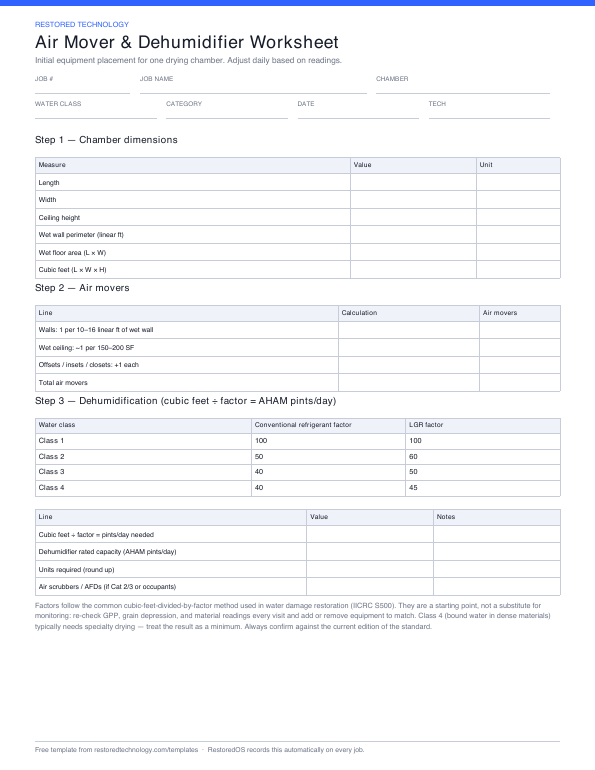
Preview of the Air mover & dehumidifier calculation worksheet

What's on the template

  • Chamber length, width, height, wet wall perimeter, floor area, and cubic feet
  • Air movers for walls (1 per 10–16 LF), wet ceiling, and offsets or closets
  • Dehumidifier factor table by class: conventional refrigerant and LGR
  • Pints per day needed, unit capacity, and units required
  • Air scrubbers / AFDs where contamination or occupants call for them

How to fill it in

  1. Measure the chamber and calculate cubic feet (length × width × height).
  2. Measure the wet wall perimeter and divide by 10–16 for wall air movers; add for the ceiling and offsets.
  3. Pick the factor for your water class and dehumidifier type, and divide cubic feet by it.
  4. Divide the pints per day by your dehumidifier’s rated AHAM capacity and round up.
  5. Treat the result as a starting point — adjust daily from the drying log and moisture readings.

Need the numbers? Use the free dehumidifier sizing calculator, air mover calculator and water damage class calculator. Industry practice per IICRC S500, 5th edition (2021) — verify against the current edition.

FAQ

Frequently asked questions

How many air movers per square foot?

Air movers are usually placed by wet wall length rather than floor area — about one per 10–16 linear feet — with extra units for a wet ceiling and for each offset, inset, or closet.

What is the dehumidifier factor for Class 2 water damage?

In the cubic-feet ÷ factor method, Class 2 commonly uses 50 for conventional refrigerant dehumidifiers and 60 for LGR units. The result is AHAM pints per day of capacity needed.

Do I round up air mover and dehumidifier counts?

Yes — always round up to whole units. Then let the readings tell you whether to add or pull equipment on the next visit.

Does Class 4 use the same method?

Class 4 (bound water in dense materials like hardwood, plaster, or concrete) usually needs specialty drying, so treat the calculated number as a minimum.

Stop re-keying paper into the job file

In RestoredOS, each chamber’s category, class, readings, and equipment-days are recorded on the job record, so equipment placement and billing tie together.

Book a walkthrough