Free template · PDF

Moisture map template

Sketch the room on the grid, number each reading point, record the dry standard, and track every point daily until it reaches the drying goal. Free PDF, print-ready.

What is moisture mapping in water damage restoration?

Moisture mapping is sketching the affected area and marking where wet materials were found and measured, then re-reading the same numbered points on every visit. With a dry standard taken from the same material in an unaffected area, it shows how far the wet area extends and proves when each material is dry.

Download the free PDF

Download Moisture map (PDF)

Letter size, landscape, print-ready. Free to use on your jobs — no sign-up, no email required.
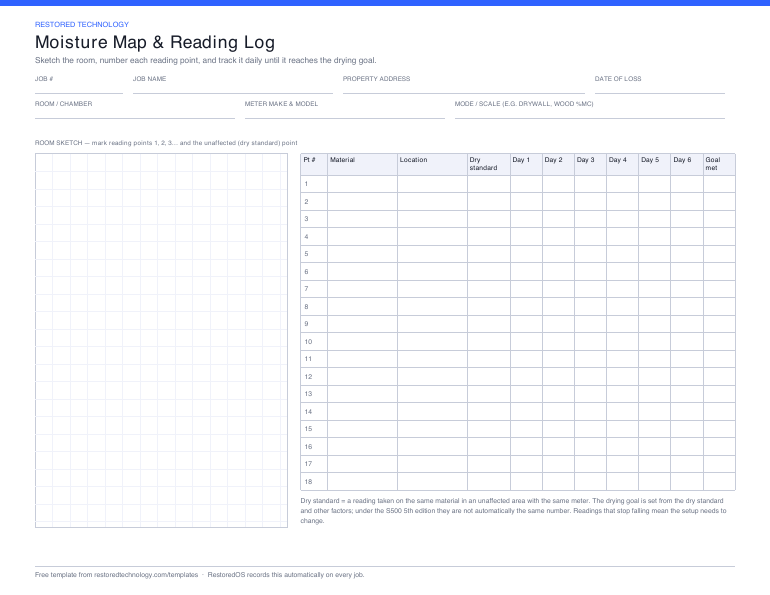
Preview of the Moisture map template

What's on the template

  • Job, property, room or chamber, meter make and model, and mode or scale
  • A gridded room sketch for marking numbered reading points
  • Up to 18 reading points: material and location
  • Dry standard for each material, taken in an unaffected area
  • Six days of readings per point, and a goal-met check

How to fill it in

  1. Sketch the room on the grid: walls, openings, cabinets, and where the water came from.
  2. Take a dry standard reading on each material type in an unaffected area with the same meter.
  3. Find the edges of the wet area and mark numbered points on the sketch, logging material and location.
  4. Re-read the same points every visit and record them under the day.
  5. Tick goal met when a point reaches the drying goal you set for that material.

Need the numbers? Use the free water damage class calculator, drying goal calculator and category & class guide. Industry practice per IICRC S500, 5th edition (2021) — verify against the current edition.

FAQ

Frequently asked questions

What is a dry standard?

A reading taken on the same type of material, in an unaffected part of the building, with the same meter. It shows what normal looks like for that material in that building.

Is the drying goal the same as the dry standard?

Not automatically. Under the S500 5th edition the dry standard is one input to the drying goal, alongside other factors — the 4th-edition shortcut of treating them as the same number no longer holds.

Why use the same meter every time?

Different meters and scales read the same material differently. Using the same meter (or cross-checking a new one) keeps day-to-day readings comparable.

Stop re-keying paper into the job file

In RestoredOS, moisture points live on the drying chamber in the job file with their daily readings, so the map, the drying log, and the photos stay on one record instead of on paper.

Book a walkthrough