Free template · PDF

Water damage drying log template

A one-page daily psychrometric log for each drying chamber — outside, unaffected, chamber, and dehumidifier exhaust readings, grain depression, and equipment on site. Free PDF, print-ready.

What goes on a water damage drying log?

A drying log records, for each chamber and each visit, the temperature and relative humidity outside, in an unaffected area, inside the chamber, and at the dehumidifier exhaust — converted to grains per pound (GPP) — plus grain depression, the equipment running, and notes on any changes. Paired with a moisture map of material readings, it documents that drying was monitored and effective.

Download the free PDF

Download Water damage drying log (PDF)

Letter size, landscape, print-ready. Free to use on your jobs — no sign-up, no email required.
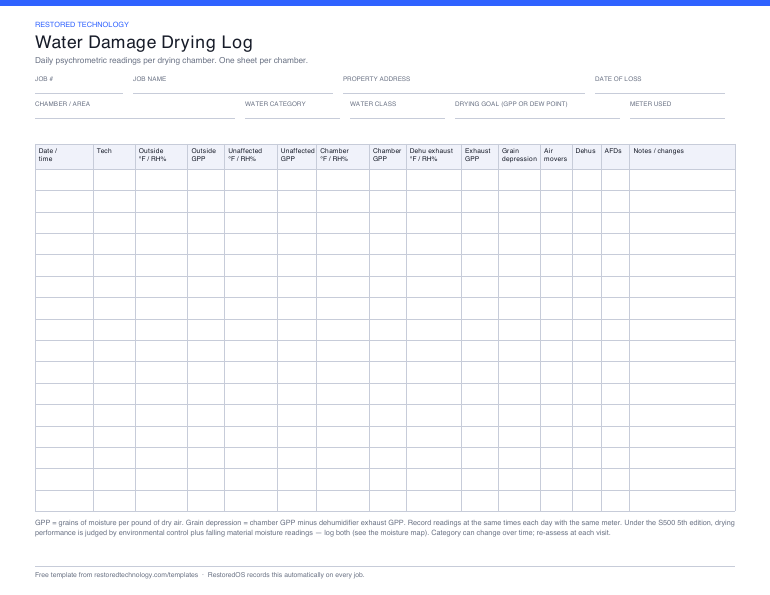
Preview of the Water damage drying log template

What's on the template

  • Job, property, date of loss, chamber, water category and class
  • Drying goal (GPP or dew point) and the meter used
  • Date, time, and technician for every visit
  • Outside, unaffected-area, chamber, and dehumidifier-exhaust °F / RH% and GPP
  • Grain depression (chamber GPP minus exhaust GPP)
  • Air movers, dehumidifiers, and air scrubbers on site that day
  • Notes on equipment added, removed, or moved

How to fill it in

  1. Fill in one sheet per drying chamber at the first visit, with category, class, and your drying goal.
  2. Take the outside and unaffected-area readings first — they are your baseline and your dry reference.
  3. Read the chamber and the dehumidifier exhaust, convert each to GPP, and subtract for grain depression.
  4. Record equipment counts every visit; equipment-days on the invoice should match this column.
  5. Visit at about the same time each day with the same meter, and note every setup change.

Need the numbers? Use the free gpp calculator, grain depression calculator and drying goal calculator. Industry practice per IICRC S500, 5th edition (2021) — verify against the current edition.

FAQ

Frequently asked questions

How often should drying readings be taken?

At least daily, at about the same time and with the same meter, until the drying goal is met. Readings that stop improving are the signal to change the setup.

What is grain depression?

Grain depression is the difference between the GPP of the air entering a dehumidifier (the chamber) and the air leaving it (the exhaust). It shows how much moisture the dehumidifier is pulling out of the air.

Is a drying log enough documentation?

No. Under the S500 5th edition, drying performance is judged by environmental control plus falling material moisture readings, so keep a moisture map alongside the drying log, and photos of the setup.

Can I use this template for insurance claims?

Yes — it is a generic record of readings and equipment. Carriers and reviewers price mitigation from documentation, so equipment days on your invoice should trace back to this log.

Stop re-keying paper into the job file

In RestoredOS, each drying chamber carries its S500 category and class, daily readings with GPP and dew point, and equipment-days on the job record — and the Mitigation Audit reviews the file for gaps before a contested invoice goes out.

Book a walkthrough